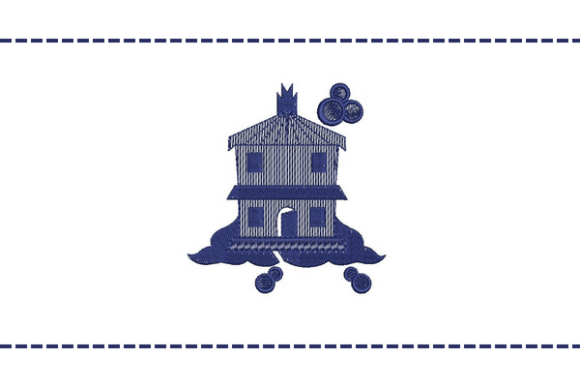
House Element: Cozy, Artistic, and Surprisingly Versatile
First Impressions: Warmth Without Cliché
When House Element loaded into my embroidery software, I paused—not because it’s flashy, but because it *feels* intentional. It’s not a cartoon house or a minimalist line drawing. It’s a gentle, hand-drawn silhouette with subtle texture in the roofline, soft curves on the windows, and just enough interior detail to suggest light, not clutter. The overall mood is quiet confidence: cozy without being twee, artistic without sacrificing clarity. That balance matters—especially when you’re stitching for someone else’s home, baby’s first blanket, or a boutique’s seasonal collection.
A Real-World Test: Embroidering a Linen Kitchen Towel
Last week, I used House Element on a heavyweight natural linen towel for a client’s small kitchen shop. No appliqué, no layered fabric—just the design stitched cleanly in ecru thread on oat-colored linen. What stood out wasn’t just how it looked, but how it *behaved*: the stitch density was even, no skipped stitches over the slight weave variation, and the satin-stitched window frames held their shape without puckering. Customers noticed it immediately—not as “a house,” but as “that lovely little house that looks like it belongs there.” That’s the sign of a well-considered machine embroidery design: it enhances the object, doesn’t compete with it.
Where House Element Shines (and Where It Asks for Thought)
House Element works beautifully on stable, medium-weight fabrics where stitch definition matters:
- Custom apparel: On cotton sweatshirts and structured tote bags, its rounded contours soften the garment’s lines instead of fighting them.
- Baby embroidery: Stitched small (under 3.5") on organic cotton onesies, it reads clearly without overwhelming delicate scale—ideal for nursery decor or personalized gifts.
- Embroidered patch: When stitched on twill with a clean merrow edge, House Element becomes a subtle brand marker—think aprons for a local café or holiday gift tags for a craft business.
- Holiday embroidery: Paired with a single red berry or tiny snowflake (added manually), it shifts effortlessly from spring porch charm to winter hearth warmth.
But it’s not universally forgiving. Use caution on:
- Stretchy fabric: Like jersey tees or baby knits—without proper cutaway stabilizer and reduced tension, those curved rooflines can distort.
- Textured or napped surfaces: Fleece, terry cloth, or bouclé will mute fine details; consider simplifying or increasing size by 15%.
- Dark fabric with light thread: The interior window lines rely on contrast—test stitch density and thread weight first. A slightly heavier thread or underlay stitch helps.
- Curved surfaces (caps, curved pillow seams): The design’s gentle asymmetry means it won’t “fall” awkwardly—but always hoop with stabilizer flush to the curve, not stretched.
What It Adds to Your Finished Product—Beyond Aesthetics
House Element quietly lifts perceived value. On an Etsy listing for handmade pillow covers, it signals care—not just “I sewed this,” but “I chose something thoughtful.” For a small shop selling embroidered tea towels, it reinforces brand consistency: warm, unhurried, human-made. And for personalized gifts? It reads as intimate, not generic. I’ve seen customers describe it as “the house I imagine living in”—which tells me it connects emotionally, not just decoratively.
That resonance matters for buyer engagement. A strong digital embroidery file like House Element doesn’t just fill space—it invites pause, recognition, and memory. When used in commercial embroidery for local businesses (think bakery aprons or library tote bags), it feels bespoke, not templated. That builds trust: your customer believes you understand their story, not just their order form.
Practical Designer Notes Before You Stitch
Before committing to your first real project, here’s what I do—and recommend:
- Test on scrap fabric that matches your final substrate—same weight, same finish, same stabilizer combo.
- Check thread color contrast in both natural and artificial light. A soft grey thread may disappear on heathered fabric unless stitch density is adjusted.
- Review stitch density in the roof and window areas—dense fill stitches can stiffen lightweight fabrics; consider switching to a lighter fill pattern if needed.
- Confirm hoop size compatibility. House Element fits comfortably in a 4x4 hoop at standard size—but if scaling up for a blanket corner or down for a baby cap, verify spacing and detail retention.
- Inspect small details at 200% zoom in your embroidery software: are window mullions legible? Does the door handle read as intentional, not stray stitch?
- Test in black and white mockups—this reveals whether contrast holds when color is removed, critical for printable mockups or grayscale product photos.
- Compare light vs. dark fabric backgrounds in your design preview. Some elements gain or lose emphasis depending on value contrast.
- Use proper stabilizer: tear-away for stable wovens, cutaway for knits or high-wear items like tote bag straps.
- Verify licensing before selling finished items or bundling House Element as part of a digital product. This creative embroidery will add a cozy and artistic feel to any fabric—yes—but only if your use aligns with its terms.
Final Thought: Not Just a House—A Quiet Anchor
House Element isn’t about architectural accuracy. It’s about emotional resonance delivered through smart digitizing: balanced weight, breathable spacing, and just enough detail to feel handmade—not machine-made. Whether you’re an Etsy seller building a cohesive line of nursery goods, a craft fair vendor stitching custom aprons, or a designer sourcing reliable embroidery file assets for client work, it earns its place in your library not because it’s trendy, but because it’s trustworthy. It stitches cleanly, photographs well, and carries warmth without shouting. In a market full of loud, complex designs, that kind of quiet strength is rare—and valuable.