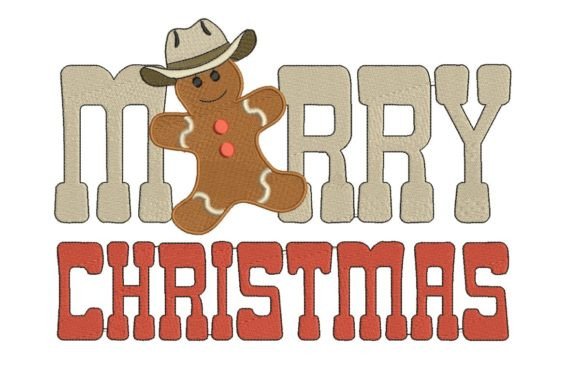
Cowboy Gingerbread Merry Christmas
A Playful Twist That Stitches With Confidence
First glance at Cowboy Gingerbread Merry Christmas delivers instant charm — a whimsical mashup of frontier grit and holiday sweetness. The cowboy gingerbread man stands upright, hat tipped, boots squared, with a stitched-on “Merry Christmas” banner looping beneath. It’s not overly detailed, but it’s intentional: clean outlines, balanced proportions, and just enough personality to read clearly at 3–4 inches tall. This isn’t a fussy heirloom motif — it’s a friendly, confident machine embroidery design built for real-world stitching, not just digital previews.
Where It Shines in Real Projects
I recently tested Cowboy Gingerbread Merry Christmas on a natural cotton canvas tote bag destined for a local craft fair — a perfect litmus test. Stitched at 3.75 inches wide with medium-weight cutaway stabilizer, the design held its shape beautifully across the fabric’s subtle weave. The satin-stitched outline around the gingerbread figure popped without stiffness, and the fill stitches settled smoothly into the background. Customers paused mid-aisle. Not because it was flashy — but because it felt *handmade*, warm, and unmistakably festive without leaning into cliché.
It works especially well for small-batch custom apparel: think crewneck sweatshirts for a family-owned bakery’s holiday staff, or baby onesies where simplicity reads as care (no tiny buttons or fragile details to snag). As an embroidered patch, it holds up cleanly when heat-applied or sewn onto denim jackets or aprons. On tea towels? Yes — the lettering stays legible after repeated washing when proper stabilizer and thread tension are used. And for Etsy sellers listing printable mockups? Its strong silhouette and clear negative space translate crisply into digital previews — no pixelation, no guesswork.
Fabrics and Fit: Know When to Lean In — and When to Pause
Cowboy Gingerbread Merry Christmas is forgiving, but not magic. On thin or loosely woven fabrics like lightweight linen or rayon challis, I recommend basting + tear-away stabilizer underneath *and* topping with a light film to prevent thread pull-through on the satin-stitched hat brim or boot details. Stretchy knits? Possible — but only with a firm cutaway base and reduced stitch density (check your file settings before hooping). Curved surfaces like caps require careful digitizing alignment; this design’s flat, centered layout makes it easier to position than many holiday motifs, but still needs precise hooping and possibly a cap frame.
Dark fabrics bring out its strength: the contrast between rich thread colors and deep backgrounds gives it instant presence. On light fabrics, avoid pale pastels unless you’re aiming for subtlety — the design benefits from bold, saturated thread choices to maintain definition. And while it’s not an applique design, don’t force dense fill areas (like the gingerbread torso) onto highly textured surfaces like bouclé or heavy terry cloth — the detail blurs. For nursery decor or baby embroidery, keep hoop size practical: 4x4" works cleanly, but go larger only if your machine handles wider stitch fields evenly.
What It Adds — Beyond Just Stitches
This isn’t just decoration. Cowboy Gingerbread Merry Christmas elevates perceived value. A plain cotton pillow cover becomes a boutique-ready holiday gift. A generic sweatshirt transforms into a conversation starter — “Wait, is that a cowboy *gingerbread*?!” — which builds buyer engagement and social sharing potential. For craft businesses, it supports brand consistency when paired with complementary designs (think rustic typography or cactus motifs), reinforcing a curated, intentional aesthetic rather than seasonal filler.
Its clarity also builds customer trust. No squinting to read “Merry Christmas.” No lost details after laundering. That reliability matters — especially for personalized gifts or wedding-related holiday items (think “Mr. & Mrs. Smith’s First Christmas” tote bags). And because it avoids over-complexity, it scales well across product types: same file, different context, consistent impact.
Designer Notes You’ll Actually Use
- Always test first — run Cowboy Gingerbread Merry Christmas on scrap fabric matching your final project’s weight and stretch.
- Check thread color contrast early — what reads well on screen may vanish on dark denim or get muddy on oatmeal linen.
- Review stitch density before scaling. If enlarging beyond 5 inches, verify fill areas don’t become overly dense or cause puckering.
- Confirm hoop size — some versions may be optimized for 4x4", others for 5x7". Don’t assume.
- Inspect small details in your embroidery software: the buckle on the belt, the curve of the smile, the spacing in “Merry Christmas.” These define professionalism.
- Test black-and-white mockups — if it reads cleanly in grayscale, it’ll hold up under varied lighting and fabric tones.
- Use proper stabilizer — medium cutaway for stable wovens, cutaway + topping for knits or sheers.
- Verify licensing — since this is a commercial embroidery file, confirm whether resale of finished products or use in digital embroidery bundles is permitted before listing on Etsy or wholesale platforms.
Final Thought: A Design That Earns Its Place
Cowboy Gingerbread Merry Christmas doesn’t shout. It invites. It fits naturally into handmade product lines, holiday collections, and small shop branding — not as a novelty, but as a thoughtful, stitch-ready asset. It’s the kind of embroidery file you save to your “go-to holiday folder,” not because it’s trendy, but because it works: on fabric, on timeline, and on people. Whether you’re stitching for joy, gifting with meaning, or selling with intention, this design earns its spot — one clean, confident stitch at a time.